If your business uses labels every day for shipping, fulfillment, retail, food service, healthcare, or warehouse operations, the label format you choose can have a big impact on efficiency. One option more companies are considering is linerless labels. These labels are also commonly called liner free labels. For many operations, they offer a cleaner, more efficient way to print and apply labels while reducing waste.
In this guide, we’ll explain how linerless labels work, how they compare to traditional labels, where they are used, and how to decide whether they are the right choice for your operation.
What Are Linerless Labels?
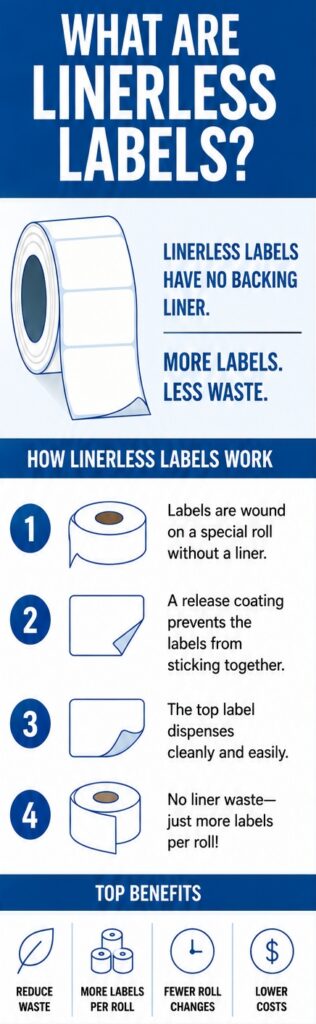
So, what are linerless labels? Linerless labels are pressure-sensitive labels made without a traditional peel-away backing. Instead, they are wound directly onto a roll and use a special release coating to prevent the adhesive from sticking to the label underneath.
Traditional labels typically have three layers: a printable face material, adhesive, and a release liner. The liner protects the adhesive until the label is applied, then it is discarded. Linerless labels eliminate that extra layer, using a coated roll that allows the adhesive to release cleanly during printing and application.
This design helps reduce liner waste and can allow more labels to fit on a roll. For high-volume operations, that can mean fewer roll changes, less storage space, and a more efficient labeling process. For businesses exploring custom label formats, Chicago Tag & Label offers linerless labels designed for performance, efficiency, and application-specific use.
How Do Linerless Labels Work?
Linerless labels are built differently than standard labels. Since there is no backing liner, the label construction must allow the roll to unwind smoothly without the adhesive sticking to itself.
A linerless label typically includes:
- Face material: The printable surface of the label
- Adhesive: The layer that helps the label bond to the application surface
- Release coating: A coating that prevents the adhesive from sticking to the next label on the roll
- Thermal-sensitive layer: Used when the label is designed for direct thermal printing
Many linerless labels are used with direct thermal printing, which means they do not require a ribbon. Instead, the printer uses heat to create the printed image. This can be helpful in fast-paced environments where teams need to print quickly and reduce extra supplies. If your operation already uses thermal printing, thermal label solutions can help you evaluate the best material, adhesive, and printer setup for your application.
5 Benefits of Linerless Labels
1. Reduced Waste
One of the biggest advantages of linerless labels is waste reduction. Since there is no backing liner to throw away, businesses can reduce the amount of discarded material created during labeling.
For high-volume operations, this can be a meaningful improvement. Shipping stations, retail counters, food service environments, and warehouses can generate a lot of liner waste when traditional labels are used all day.
Removing the liner helps create a cleaner work area and supports businesses that are looking for more waste-conscious labeling options. For broader waste reduction guidance, the EPA’s sustainable materials management hierarchy is a helpful resource.
2. More Labels Per Roll
Since linerless labels do not include backing paper, more label material can typically fit on a roll. That means fewer roll changes throughout the day.
For busy teams, fewer roll changes can help reduce interruptions and keep work moving. This is especially useful in shipping, fulfillment, retail, and warehouse environments where every minute matters.
3. Improved Workflow Efficiency
Linerless labels can help streamline labeling workflows in several ways. Employees do not need to remove and discard liners, rolls may last longer, and work areas can stay cleaner.
Common workflow benefits include:
- Less liner cleanup
- Fewer roll changes
- Reduced downtime
- More efficient label application
- Cleaner packing and labeling stations
- Better support for high-volume operations
For businesses with fast-moving labeling needs, these improvements can add up quickly.
4. Lower Storage and Shipping Needs
When rolls hold more labels, businesses may need less storage space for label inventory. Fewer rolls may also mean fewer cartons, cores, and handling requirements.
This can be helpful for facilities where storage space is limited or where teams want to reduce the amount of label inventory they need to manage.
5. Sustainability
Linerless labels are often discussed as a more sustainable labeling option because they reduce liner waste. For companies looking to improve operational efficiency and reduce material disposal, they can be a practical step in the right direction.
Read More: Common Label Material Types & Applications
Common Applications for Linerless Labels
Linerless labels are used in many industries, especially where labels are printed frequently and applied quickly.
Shipping and Fulfillment
Shipping and fulfillment operations often rely on fast, accurate label printing. Linerless labels can help reduce liner waste at packing stations and support efficient order processing.
They may be used for shipping information, carton identification, packing workflows, and short-term package labeling. For businesses with broader shipping needs, Chicago Tag & Label also offers custom shipping labels designed for accuracy and performance.
Warehouse and Distribution
Warehouses need labels that help teams identify, track, and move inventory efficiently. Linerless labels can support carton labeling, inventory movement, temporary tracking, and fast-paced distribution workflows.
They can also fit into a larger warehouse labeling strategy that includes warehouse pallet labels and warehouse distribution labeling solutions.
Retail and Food Service
Retail and food service environments often use labels for pricing, product identification, scale labels, receipts, food packaging, and variable-length labeling.
Linerless labels can be useful because they allow flexible label lengths and reduce backing waste during frequent printing. Retailers using barcodes for product identification may also benefit from custom retail barcode labels when long-term scan consistency is needed.
Healthcare and Pharmacy
Healthcare environments rely on clear, accurate labeling for patient safety, medication management, lab workflows, and short-term tracking. Linerless labels may be useful for certain healthcare and pharmacy applications where fast printing and reduced waste are important.
For applications involving patient identification, medical records, or medication tracking, Chicago Tag & Label offers healthcare labels and wristbands designed for dependable healthcare workflows.
Manufacturing
Manufacturing facilities use labels throughout production, packaging, inventory control, and shipping. Linerless labels may support temporary identification, work-in-process labeling, packaging, and internal tracking. For more demanding production environments, manufacturing labels may be needed when labels must withstand abrasion, handling, chemicals, or other harsh conditions.
Read More: How to Choose a Shipping Label Size
Are Linerless Labels Right for Every Application?
Linerless labels offer strong benefits, but they are not the right fit for every situation. Before switching, it is important to consider your equipment, environment, adhesive needs, and label performance requirements.
Printer Compatibility
Linerless labels typically require printers or applicators designed to handle them. Since there is no liner protecting printer components from adhesive, compatible equipment often uses non-stick surfaces, special rollers, cutters, or other design features.
If your current printers are not built for linerless labels, you may need to evaluate equipment compatibility before making the switch.
Adhesive and Surface Requirements
As with any label, the adhesive must match the surface. A label used on cardboard may require a different adhesive than one applied to plastic, metal, glass, or packaging film.
Before full production, it is always smart to test the label on the actual surface and under real operating conditions.
Durability Needs
Some applications require labels that resist moisture, abrasion, chemicals, outdoor exposure, or extreme temperatures. In those cases, linerless labels may not always be the best choice.
For specialized applications, custom label printing solutions can help you choose the right material, adhesive, and construction for the environment.
How to Choose the Right Linerless Label Solution
Choosing the right linerless label starts with understanding how it will be used. A label that works well in a retail setting may not be the best fit for a warehouse, pharmacy, or manufacturing facility.
Use this process as a starting point:

- Identify the surface the label will be applied to.
- Determine whether the label is short-term or long-term.
- Confirm printer compatibility.
- Choose the right adhesive.
- Consider barcode, variable data, or branding needs.
- Test the linerless label before full production.
- Work with a custom label manufacturer to match the label to your workflow.
Chicago Tag & Label can help businesses evaluate linerless labels based on application, label size, printing needs, adhesive requirements, and production volume.
Linerless Labels and Barcode Printing
Many businesses use linerless labels for barcode applications, especially in shipping, retail, warehousing, and fulfillment. When barcodes are involved, print clarity is critical.
A barcode label must remain readable throughout its intended use. Poor print quality, incorrect sizing, material issues, or adhesive problems can all create scanning errors.
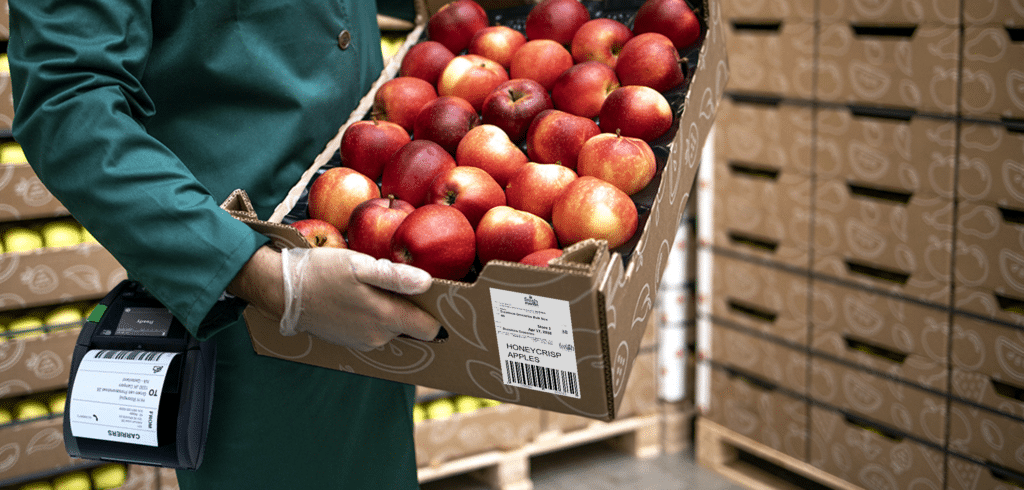
When using barcodes on linerless labels, consider:
- Barcode size and spacing
- Print darkness settings
- Label surface quality
- Scan distance
- Variable data requirements
- Printer compatibility
- Application environment
For durable barcode applications, Chicago Tag & Label also manufactures industrial barcode labels built for demanding environments. For additional guidance on barcode quality and formatting, GS1 provides helpful information on barcode standards.
Why Work with Chicago Tag & Label for Linerless Labels?
Every labeling application is different. The right label depends on the surface, environment, printer, adhesive, workflow, and business goal.
Chicago Tag & Label works with businesses to create custom label solutions that fit real-world applications. Our capabilities include custom label formats, variable data, barcodes, application-specific adhesives, high-volume label production, and industry-specific label support. Whether you need linerless labels, thermal label solutions, shipping labels, warehouse labels, or custom label printing for a specialized application, our team can help match the label construction to the job. Give our team a call at +1 (800) 826-8260 to receive assistance choosing linerless labels for your project.