When it comes to food packaging, there are several elements that play a key part in helping your product stand out on crowded grocery store shelves, but few aspects are as impactful and far-reaching in significance as the food label.
Since more and more consumers are taking the time to analyze labels prior to loading up their cart, maintaining an accurate account of your product’s nutritional value and displaying it accurately by FDA standards is more important than ever. If you are a business owner, you may be wondering what is required on food labels. Prior to designing your labels, it is important to take a quick review of basic requirements.
General Food Label Requirements
Prior to plugging in product-specific content, your future food label needs to measure up to FDA-mandated formatting. The goal is to ensure consumers can locate and read pertinent information along with font, color and sizing.
- Nutritional information must be separated from the rest of the label design using a bordered box
- The “Nutrition Facts” heading will be the largest print on the label and should span the entire width of this section.
- Other nutritional information must appear in no smaller than a 6- to 8-point font
- Text must be printed in one color type against a neutral background for maximum contrast and legibility
Read More: Freezer Grade Labels – Benefits and Applications
Essential Information
The next major food label requirement you need to follow includes listing ingredients in descending order according to volume/weight or prominence in the recipe or mixture. Even the most basic or obvious ingredients like water or an item listed in the product name (“beef” for a package of Bob’s Bourbon-Braised Beef Ribs, for example) must be disclosed.
Beyond that, there are several other mandated categories:
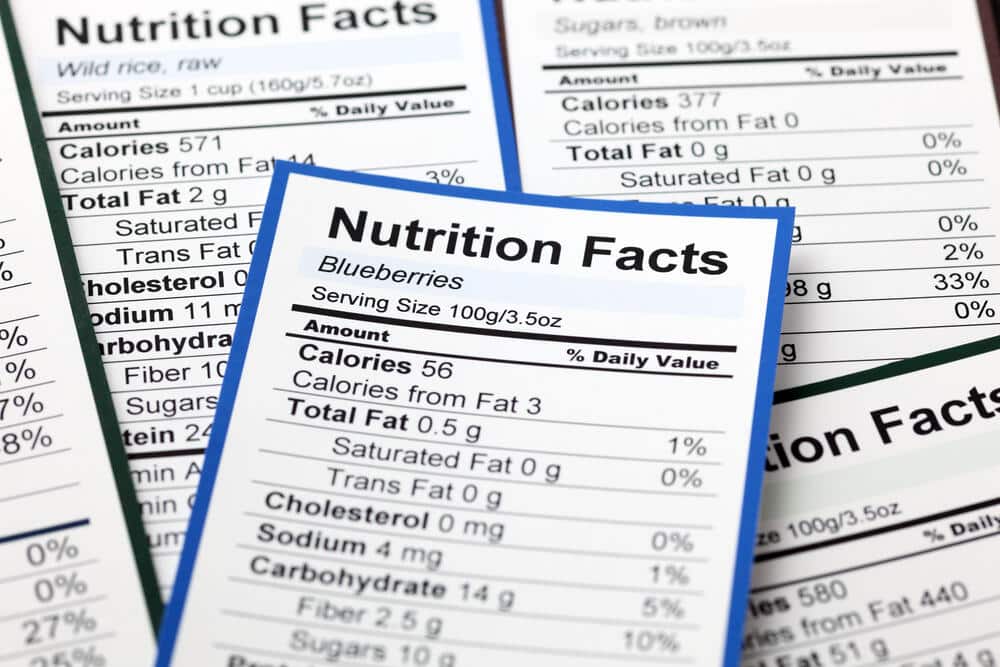
- Nutritional Facts: A comprehensive listing of per-serving values for calories, fat, cholesterol, sodium, total carbohydrates (a category then further broken down into dietary fiber and sugars) and protein. Vitamins and minerals appear in a box below the main nutritional information; more common nutrients like vitamins A, B, C and D, iron and calcium are required, as are any that are used in promotional or marketing claims.
- Percentage of Daily Values: Ingredient information must be listed in two ways: by calories, measurement or weight, and as a percentage of the FDA’s recommend daily value based on a 2,000- or 2,500-calorie diet (or both).
- Allergens: If a product contains any of the top eight allergens (milk, eggs, fish, shellfish, tree nuts, peanuts, wheat, and soybeans) or is processed, this information must be disclosed on the label.
Regulated Lingo
While the meaning behind terms such as low fat (less than 3g of fat per serving), low cholesterol (20mg or less per serving) or zero trans fat (contains less than 0.5g per serving) aren’t FDA-required disclosures on food labels, any such health claims must be backed up by laboratory testing and printed nutritional information.
While this is by no means a comprehensive list of food labeling fundamentals, it should give owners a jump start on creating consumer-friendly labels that also meet government benchmarks for quality and nutritional disclosure — two ideals necessary for success when marketing packaged food.
Custom Labels and Printing Solutions
Creating an accurate food label is an important part of preparing your product for the shelf. From nutrition facts and ingredient lists to allergen disclosures, serving information, and readable formatting, every detail helps customers understand what they are buying while supporting your labeling requirements.
If your business needs dependable printed labels for packaged food, beverage products, retail packaging, or related applications, Chicago Tag & Label can help you create clear, professional labels built around your product needs. The expert team from our Chicago label company offer reliable custom labels and are available to help you with your next flood labeling project. Give our staff a call at (800) 826-8260 to receive assistance.