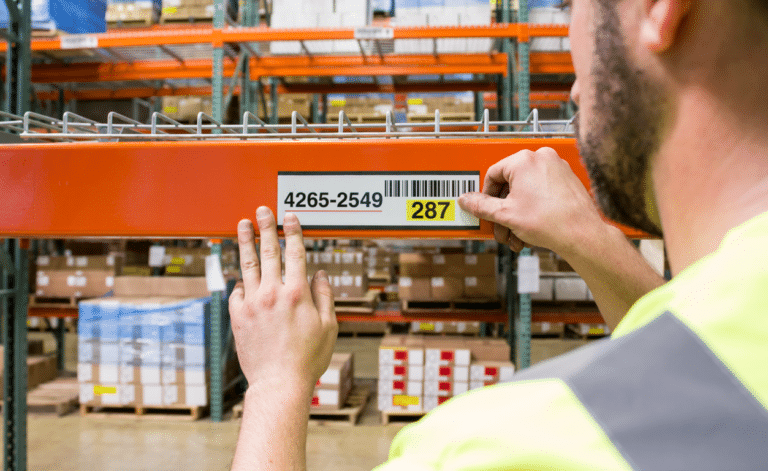
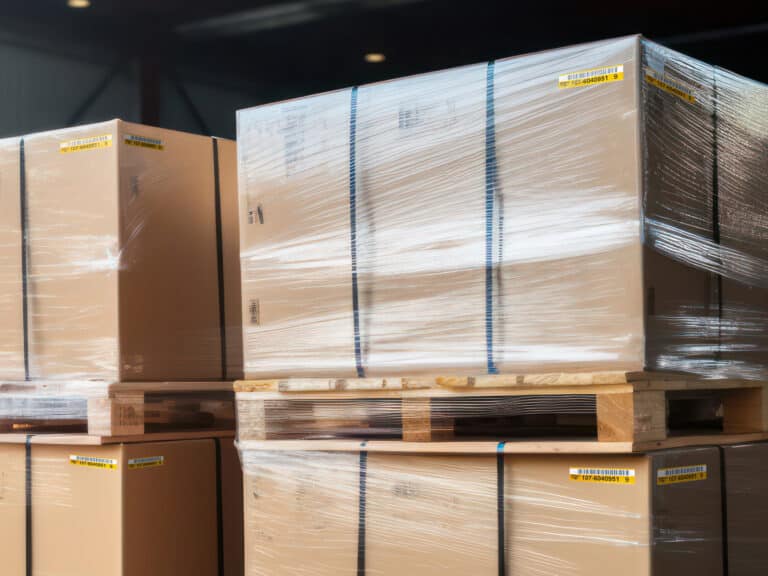
A shipping label needs to stay with its carton. A temporary inventory label needs to come off without leaving residue behind. Those are different requirements, and choosing the strongest adhesive will not solve both.
The right label adhesives depend on the surface, operating conditions, and how long the label needs to last. Understanding these requirements helps you avoid discovering a mismatch after the labels reach your production floor.
What Are Label Adhesives?
Label adhesives attach the printed label material to a surface. This guide focuses on pressure-sensitive adhesives, which form a bond when pressure is applied. They do not require water or heat to activate during normal application.
The adhesive is one part of the label. The printable face material and release liner also affect performance and processing. Our guide to label materials and construction explains how those components work together.
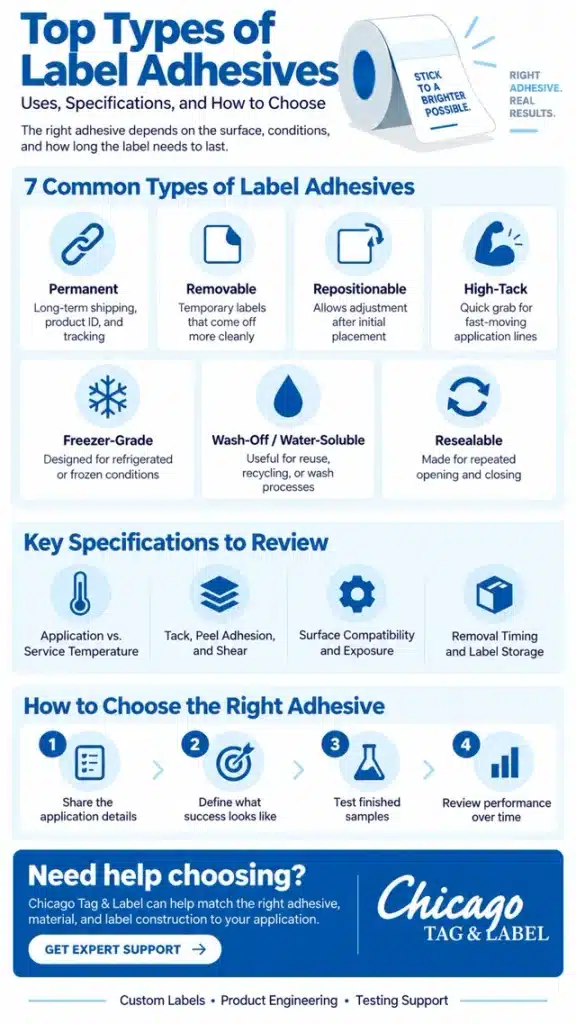
7 Common Types of Label Adhesives
These categories describe different jobs, not a strongest-to-weakest ranking. Some overlap: a label can be permanent and also designed for cold-temperature use.
1. Permanent Adhesives
Permanent adhesives are designed to keep a label attached throughout its intended service life. Consider them when shipping information, product identification, or tracking details need to remain with an item.
However, “permanent” does not mean suitable for every surface. A formulation selected for a carton may not meet the requirements of a plastic container. The label material, surface, exposure conditions, and required lifespan all matter.
Start by telling our team where the label will go and what it must withstand, rather than requesting a permanent adhesive alone.
2. Removable Adhesives
Removable adhesives hold a label during use while allowing it to be taken off afterward. They are worth discussing for temporary identification and items that need relabeling.
Clean removal depends on the application. An adhesive that removes neatly from one surface may leave residue on another. The time before removal also needs to be specified.
For a reusable container, test both attachment and removal. A label that stays put but leaves adhesive behind has only met half the requirement.
3. Repositionable Adhesives
Repositionable adhesives allow an adjustment after initial placement. They can help when a label needs careful alignment rather than an immediate, difficult-to-correct bond.
Avery Dennison explains that short-term repositionable adhesives use low initial tack and slower adhesion buildup to create that adjustment window.
Repositionable does not automatically mean repeatedly reusable. Ask how long repositioning remains possible and what bond develops afterward.
4. High-Tack Adhesives
High-tack adhesives provide a strong initial grab with limited contact time or pressure. That quick attachment can be useful on fast-moving application lines.
But initial stickiness does not tell the whole story. High tack does not automatically mean the highest peel strength or strongest long-term hold.
When comparing these types of adhesives, consider what happens immediately after application. Does the package move straight into handling? Does the label wrap around a curve? Share those details rather than treating high tack as a universal upgrade.
5. Freezer-Grade and Cold-Temperature Adhesives
Cold-temperature adhesives address labeling requirements in refrigerated or frozen environments. The important question is not simply, “Will this go in a freezer?”
Will the label be attached before freezing or applied directly to a cold package? Check both application and service temperatures for the specific product. A label that tolerates freezing after attachment is not necessarily suitable for application to an already-frozen surface.
Also document moisture, condensation, and any frost present during application so your supplier can evaluate those conditions.
6. Wash-Off and Water-Soluble Adhesive Systems
Wash-off adhesives allow labels to release during the intended washing process. They can be useful when containers need to be cleaned, reused, and relabeled. UPM’s wash-off label guidance discusses applications involving container reuse and recycling.
Water-soluble systems take a different approach. With a suitable dissolvable label material, the label and adhesive can wash away rather than requiring the label to be peeled off.
Confirm the washing temperature, detergent, and wash time with your supplier. Do not assume every wash-off label dissolves or suits every recycling process.
7. Resealable Adhesives
Resealable adhesives are designed for repeated opening and closing, such as labels used as package closures.
Unlike an adhesive intended only for initial repositioning, a resealable option must continue working through multiple uses. Packaging material, the force pulling the closure open, and exposure to moisture or oils can affect the result.
Specify the expected opening cycles and test the closure with the actual package and contents.
Label Adhesive Specifications to Review Before Ordering
Category names narrow the search. Label adhesive specifications help determine whether a particular product fits your application.
Application Temperature and Service Temperature
Minimum application temperature concerns conditions when attaching the label. Service temperature describes its operating range after application.
Tack, Peel Adhesion, and Shear Resistance
These measurements describe different properties:
- Tack: How readily the adhesive forms an initial bond.
- Peel adhesion: Resistance to being pulled away from the surface.
- Shear resistance: Resistance to sliding under a sustained load.
Understanding tack, peel, and shear performance helps you look beyond a general promise of strong adhesion.
Surface Compatibility and Exposure
Identify the exact material rather than writing only “plastic” or “metal.” Include coatings, texture, curvature, and expected surface contamination.
Then document water, oils, cleaning chemicals, sunlight, heat, and handling. Evaluate the entire label construction, including whether the printed information remains readable, not just whether the adhesive stays attached. Both the adhesive and printable material need to match the operating environment.
Removal Timing and Stock Storage
Specify when removal should occur and whether residue or surface marking is acceptable. Separately, ask about the shelf life and storage conditions for unused labels. Storage requirements vary by product and should not be confused with the applied label’s service life.
When Adhesive Placement Matters
Sometimes the location of the adhesive matters as much as its performance.
Chicago Tag & Label’s pattern adhesive labels place adhesive in selected areas, leaving other areas adhesive-free. This approach can help control adhesive seepage at the edges and support feeding through high-speed laser printers.
Pattern adhesive is a construction method, not another adhesive chemistry. It belongs in the discussion when printer performance or adhesive-free areas are part of your requirements.
How to Choose and Test the Right Adhesive
Before approving production, follow these steps:
- Share the application details. Provide the surface material, label dimensions, required lifespan, and printing equipment.
- Define success. Decide what acceptable attachment, readability, and removal should look like.
- Test finished samples. Use the actual surface and application process, including expected temperatures and exposures.
- Review performance over time. Check after the relevant storage, handling, or cleaning cycle, not only immediately after application.
Chicago Tag & Label’s testing and quality-control capabilities include application testing and simulated environmental conditions to evaluate the finished product.
Get Help Choosing Label Adhesives
You do not need to arrive with a finished specification. Start with the item you are labeling, the conditions it will encounter, and what has or has not worked before.
Chicago Tag & Label provides custom label design and adhesive selection support, including in-house product engineering, material guidance, and printer compatibility considerations.
View our selection of custom labels and contact our team by phone at (800) 826-8260 to discuss your project. We will help you choose the correct type of label material and adhesive for your unique application.