Barcode vs. RFID Labels: What’s the Difference and Which One Should You Choose?
Businesses use labels every day to track products, inventory, shipments, assets, pallets, cartons, equipment, and retail merchandise. Two of the most common identification technologies are barcodes and RFID. Both can improve accuracy, speed up workflows, and help teams understand where items are, but they work in different ways.
When comparing barcodes vs RFID, the right choice depends on how your items need to be scanned, how quickly they move through your operation, what level of visibility you need, and how much you want to invest in your labeling system.
Barcode labels are familiar, cost-effective, and widely used in retail, warehousing, manufacturing, logistics, and shipping. RFID labels can support faster scanning, automation, and item-level visibility without always requiring direct line of sight. For many businesses, the answer is not one or the other. It may be a combination of both.
Barcode vs RFID: Quick Comparison
Before getting into the details, here is a simple way to compare barcode labels vs RFID labels.
| Feature | Barcode Labels | RFID Labels |
|---|---|---|
| How they work | Use printed codes scanned visually | Use an embedded RFID inlay, chip, and antenna |
| Scanning method | Scanner reads the visible barcode | RFID reader uses radio frequency |
| Line of sight | Usually required | Often not required |
| Read speed | Usually scanned one at a time | Can often scan multiple items at once |
| Cost | Typically lower | Typically higher |
| Best for | Retail, shipping, warehouse, LPN, product, and industrial tracking | Automation, bulk reading, inventory visibility, asset tracking, and supply chain workflows |
| Chicago Tag examples | Retail barcode labels, industrial barcode labels, LPN barcode labels | RFID labels, RFID sticker tags, industrial RFID tags |
The key takeaway is simple: barcode labels are often the better fit when you need a reliable and affordable scanning solution. RFID labels may be the better fit when you need faster reads, automation, or scanning without direct visual contact.
What Are Barcode Labels?
Barcode labels use printed lines, patterns, or two-dimensional codes that represent data. When a barcode scanner reads the code, it connects that item to information in a database, inventory system, point-of-sale system, warehouse management system, or shipping platform.
Barcode labels can be used on products, cartons, pallets, racks, totes, equipment, tools, and industrial assets. They can include common barcode formats such as UPC codes, Code 39, Code 128, QR codes, Data Matrix codes, serialized numbers, product IDs, lot numbers, batch codes, or other variable data.
Chicago Tag & Label manufactures many types of barcode solutions, including retail barcode labels, industrial barcode labels, and custom LPN barcode labels.
Barcode labels are popular because they are practical. They are easy to print, easy to apply, easy to scan, and compatible with many existing business systems.
Barcode vs RFID Labels Infographic
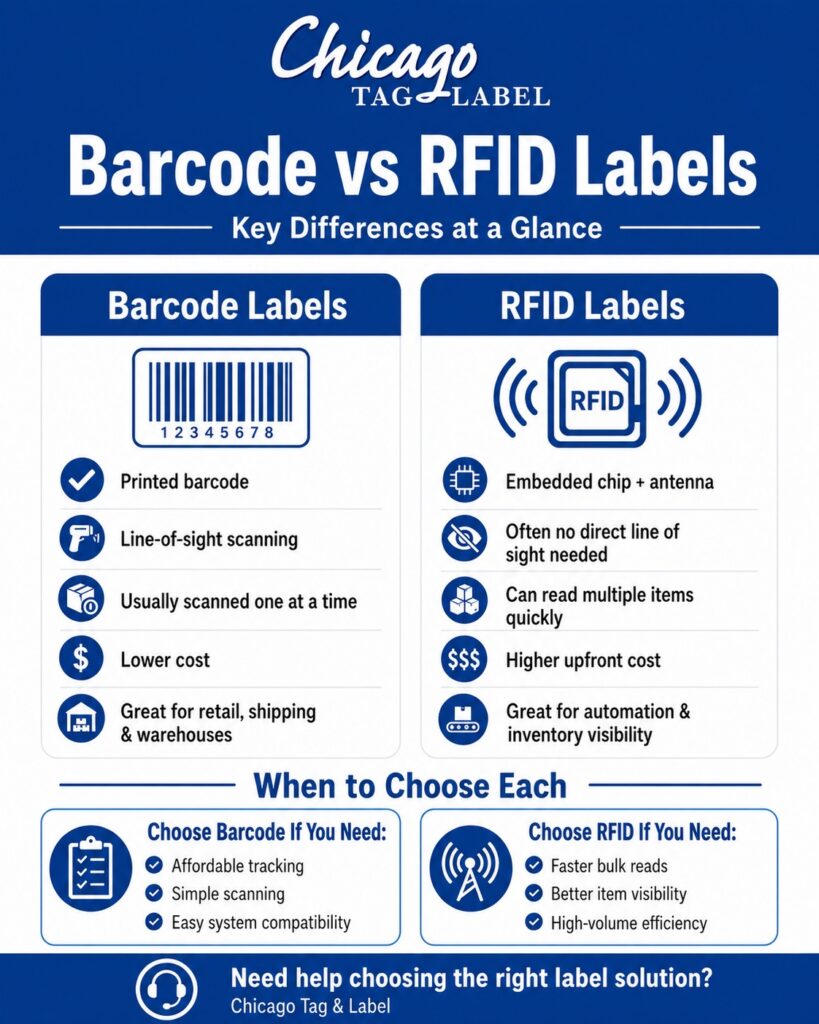
What Are RFID Labels?
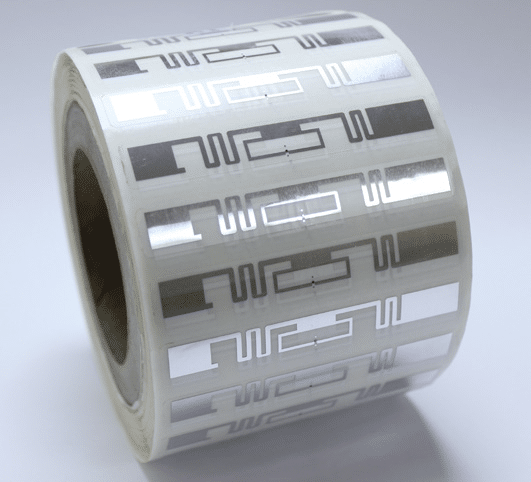
RFID labels use radio frequency identification technology. Instead of relying only on a printed code, an RFID label includes an embedded inlay with a chip and antenna. An RFID reader sends a radio frequency signal, and the label responds with stored identification data.
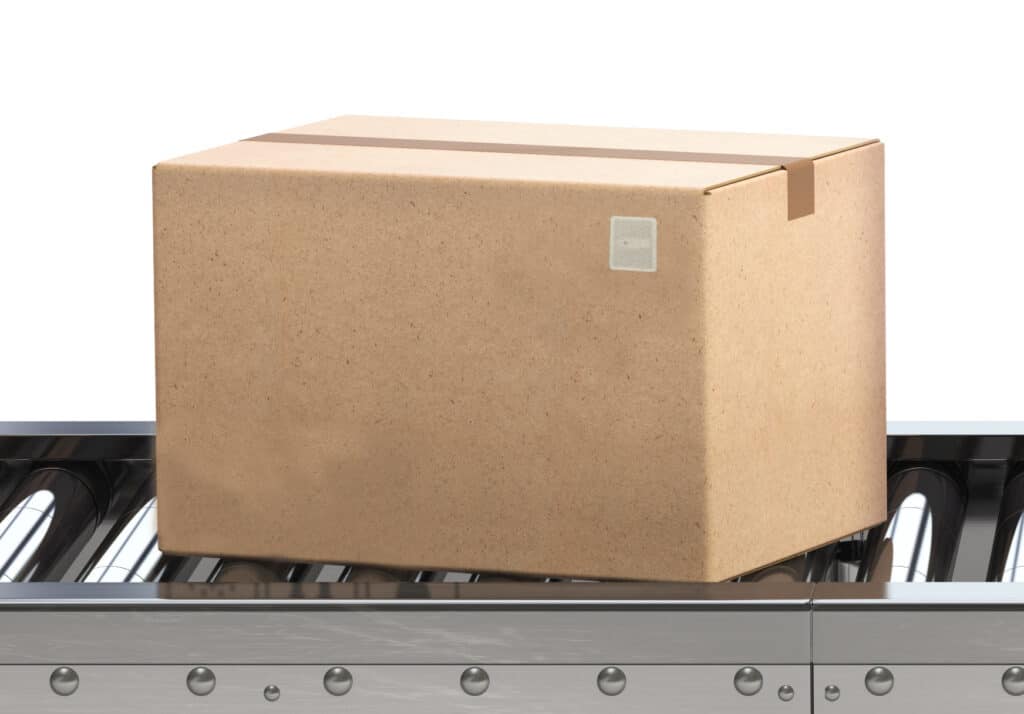
This means RFID labels can often be read without direct line of sight. In some workflows, multiple RFID labels can be read at the same time. That makes RFID useful for inventory visibility, logistics, retail tracking, healthcare assets, manufacturing, and supply chain applications where speed and automation matter.
Chicago Tag & Label offers RFID labels, RFID sticker tags, durable RFID tag labels, and industrial RFID tag solutions. These labels can be designed around your application, surface, environment, inlay needs, printer compatibility, and tracking requirements.
Key Differences Between Barcode and RFID Labels
When comparing barcodes vs RFID, there are several practical differences that matter most.
Line-of-Sight Scanning
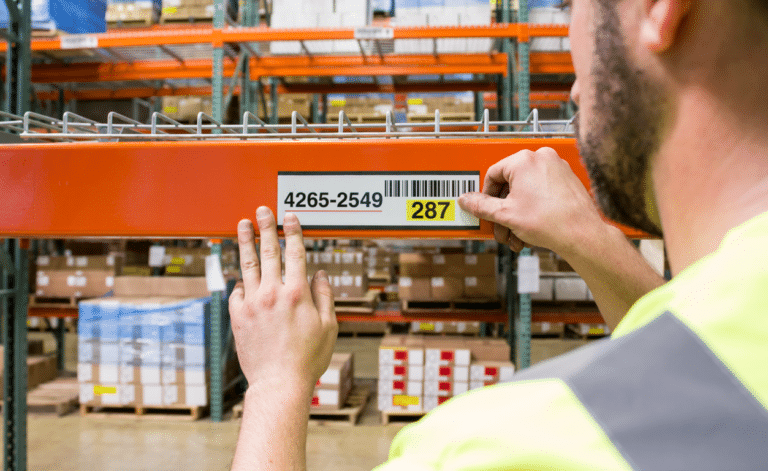
Barcode labels usually need to be visible to the scanner. This works well when employees can easily access and scan each item.
RFID labels can often be read without direct line of sight. That can be useful when items are inside cartons, moving through a process, stacked together, or difficult to reach.
Read Speed
Barcode labels are usually scanned one at a time. This is reliable and manageable for many retail, warehouse, shipping, and inventory workflows.
RFID labels can often be read faster and in groups, depending on the system, reader, tag type, surface, and environment. This can help reduce manual scanning time in high-volume operations.
Cost
Barcode labels are usually more affordable than RFID labels. They are also easier to add to existing workflows because many businesses already use barcode scanners and barcode-based systems.
RFID labels typically require more investment. In addition to the label itself, a business may need RFID readers, software, testing, process planning, and system integration. The higher cost may be worth it when RFID improves speed, visibility, or labor efficiency.
Data and Tracking Capabilities
Barcodes usually represent data that connects to a system. The barcode itself may contain an item number, product code, shipment ID, serial number, or other identifier.
RFID labels can support more automated identification because the chip and antenna communicate with the reader. RFID can be helpful when businesses need item-level tracking, faster inventory counts, or better visibility across a supply chain.
Durability and Environment
Both barcode and RFID labels can be customized for different environments.
For example, Chicago Tag & Label manufactures rugged industrial barcode solutions, including durable labels, barcode labels, and custom tag constructions for harsh environments. RFID labels can also be built around specific surfaces, handling needs, durability requirements, and read conditions.
In both cases, the material, adhesive, surface, exposure, and handling process matter.
When Barcode Labels Are the Better Fit
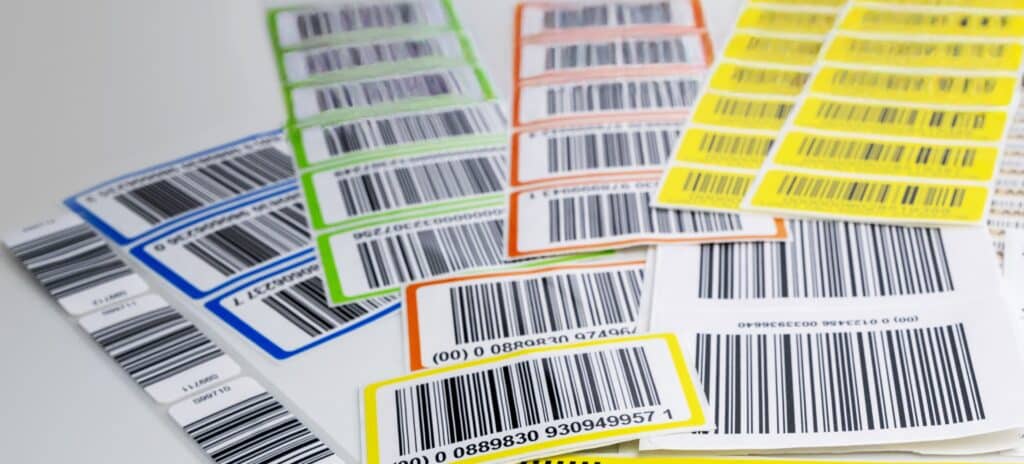
Barcode labels may be the better choice when your business needs reliable identification without the cost or complexity of RFID.
Barcode labels are often a strong fit when:
- Cost control is important.
- Items are scanned one at a time.
- The label is easy to see.
- Your team already uses barcode scanners.
- You need product labels, shipping labels, retail labels, warehouse labels, LPN labels, or industrial barcode labels.
- You need custom labels that can include product data, pricing, barcodes, serial numbers, lot numbers, or other variable information.
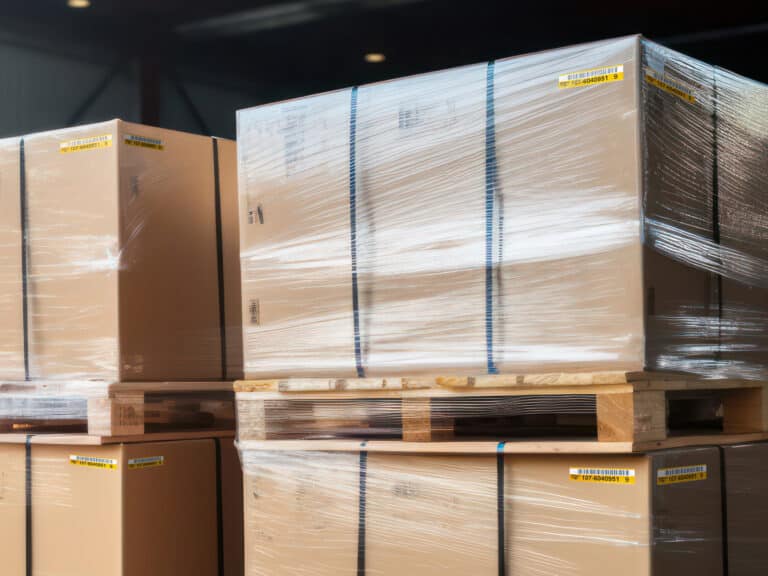
Chicago Tag’s retail barcode labels are built for point-of-sale systems, inventory management, product packaging, apparel, and merchandise. Our custom LPN barcode labels help warehouses track pallets, cartons, cases, totes, and inventory. For tougher environments, our industrial barcode labels can support asset tracking, equipment identification, traceability, and rugged industrial workflows.
When RFID Labels Are the Better Fit
RFID labels may be the better fit when the goal is faster scanning, improved automation, or better item-level visibility.
RFID labels are often useful when:
- Items need to be scanned quickly.
- Multiple items need to be read at the same time.
- Direct line of sight is not practical.
- Your operation needs better inventory visibility.
- You are using automation.
- You need item-level tracking across a supply chain.
- Your workflow supports RFID readers and software.
Chicago Tag’s RFID labels can support logistics, retail, healthcare, manufacturing, supply chain tracking, high-speed workflows, asset monitoring, and security validation. They can also be designed to work with specific inlays, materials, surfaces, printers, and encoding requirements.
Can Barcode and RFID Labels Be Used Together?
Yes. Many businesses do not need to choose only one technology.
A label can include a visible barcode and RFID functionality. The barcode supports familiar visual scanning, while RFID supports faster or automated identification. This type of hybrid approach can be useful when a business is transitioning from barcode scanning to RFID or when different teams need different scanning options.
This is where the phrase RFID barcodes sometimes appears. Technically, RFID and barcodes are different identification technologies. However, people may use the phrase RFID barcodes when they are looking for a label that includes both a printed barcode and RFID functionality.
A combined barcode and RFID label strategy can offer flexibility. The barcode gives employees a visible backup scanning method, while RFID can support faster reads and improved visibility in the right workflow.
Barcode vs RFID for Common Business Applications
The best way to choose between barcode and RFID is to look at the actual workflow.
Retail Inventory and Point-of-Sale
In retail, barcode labels are commonly used for pricing, checkout, inventory, product packaging, and apparel tags. They are simple, affordable, and compatible with point-of-sale systems.
RFID labels may be useful when retailers need faster inventory counts, item-level visibility, or better stock tracking across locations.
For many retailers, barcodes handle checkout and basic inventory needs. RFID may add value when speed and visibility become bigger priorities.
Warehousing and Distribution
Warehouses often rely on barcode labels for pallets, cartons, totes, bins, racks, LPN labels, shipping, and receiving. Barcodes work well when scan points are controlled and workers can scan each label visually.
RFID may be useful in warehouses where items move quickly, inventory counts need to happen faster, or automation is part of the workflow.
A warehouse may use LPN barcode labels for pallets and cartons while also using RFID for higher-speed inventory or movement tracking.
Manufacturing and Industrial Tracking
Manufacturing environments often use barcode labels for parts, work-in-process tracking, quality control, equipment identification, serialized products, and industrial assets.
RFID can support automation and better visibility across production lines, supply chains, or asset management processes.
Durability matters in both cases. Labels may need to resist abrasion, moisture, chemicals, heat, dirt, oil, or repeated handling.
Logistics and Supply Chain
Barcode labels are widely used for shipping, routing, receiving, inventory control, and package identification. They are practical and dependable for many logistics operations.
RFID can help improve visibility across high-volume supply chain environments where items need to be identified quickly or without direct line of sight.
The best solution depends on how items move, how they are scanned, what systems are in place, and what level of visibility is required.
Healthcare and Regulated Environments
Barcode labels can support product identification, inventory management, UDI labeling, lot tracking, and traceability. RFID labels may be useful for asset visibility, item tracking, and process automation.
In regulated environments, accuracy and scannability are critical. The label must fit the system, surface, and workflow.
What About 2D Barcodes and QR Codes?

Barcodes are not limited to traditional one-dimensional lines. Two-dimensional barcodes, such as QR codes and Data Matrix codes, can connect users and systems to more information in a compact space.
This matters because barcode technology is continuing to evolve. GS1 provides information about barcode standards, including how barcodes are used for identification across industries. GS1 also explains the growing role of 2D barcodes, which can support more data and digital connections than traditional linear barcodes.
GS1 US has also published information about Sunrise 2027, an industry initiative focused on preparing point-of-sale systems to accept 2D barcodes in addition to traditional UPC barcodes.
This does not mean 2D barcodes replace RFID in every situation. Instead, it gives businesses more options. Some workflows may work well with traditional barcodes. Others may benefit from QR codes or Data Matrix codes. Some may require RFID. Others may use both.
How to Choose Between Barcode and RFID Labels
When comparing barcode labels vs RFID labels, start with your actual process.
Ask these questions:
- Do items need to be scanned one at a time or in groups?
- Is line-of-sight scanning practical?
- What is your budget?
- How fast do items move through your operation?
- Do you need real-time or near-real-time visibility?
- Are your current systems barcode-based, RFID-ready, or both?
- What surfaces will the labels be applied to?
- Will the labels face moisture, abrasion, heat, chemicals, or outdoor exposure?
- Do you need custom materials, adhesives, sizes, or formats?
- Are you tracking products, pallets, cartons, assets, equipment, or inventory?
If the process is simple, visible, and cost-sensitive, barcode labels may be the right choice. If the process needs faster reads, automation, or item-level visibility without direct line of sight, RFID may be worth considering.
Custom Barcode and RFID Labels From Chicago Tag & Label
Choosing between barcodes vs RFID does not need to be confusing. Chicago Tag & Label can help you compare your scanning process, inventory goals, surface requirements, durability needs, workflow, and budget to find the right label solution.
We manufacture barcode labels, RFID labels, retail barcode labels, industrial barcode labels, custom LPN barcode labels, RFID sticker tags, durable RFID labels, and related custom label solutions. Our team can help with materials, adhesives, sizes, formats, variable data, durability requirements, and label constructions designed around how your items need to be scanned, stored, shipped, and managed.
Whether your business needs dependable barcode tracking, RFID visibility, or a hybrid label that supports both, contact Chicago Tag & Label by phone at (800) 826-8260 to to receive assistance.
FAQs About Barcode vs RFID Labels
What is the main difference between barcode and RFID labels?
The main difference is how they are scanned. Barcode labels are scanned visually using a printed code. RFID labels use an embedded chip and antenna that communicate with an RFID reader through radio frequency.
Is RFID better than barcode?
RFID is not always better. RFID can be useful for faster, automated, or non-line-of-sight scanning. Barcodes are usually more cost-effective, familiar, and reliable for many standard workflows.
Are barcode labels cheaper than RFID labels?
Yes. Barcode labels are generally less expensive than RFID labels. RFID may require a larger investment because it can involve RFID labels, readers, software, testing, and integration planning.
Can RFID labels be scanned without line of sight?
In many applications, yes. RFID labels can often be read without direct visual contact, depending on the reader, tag type, surface, environment, and system setup.
Can barcode and RFID labels be used together?
Yes. Many businesses use both. A label can include a visible barcode for standard scanning and RFID functionality for faster or automated identification.
When should I use barcode labels?
Barcode labels are a strong fit for retail products, shipping, warehouse labels, LPN labels, product tracking, inventory control, and industrial barcode applications where line-of-sight scanning works well.
When should I use RFID labels?
RFID labels may be a strong fit for bulk scanning, item-level inventory visibility, warehouse automation, retail inventory management, logistics, healthcare, manufacturing, and supply chain tracking.
What are RFID barcodes?
RFID barcodes is a phrase people sometimes use when they are looking for labels that combine RFID technology with a printed barcode. Technically, RFID and barcodes are different technologies, but a custom label can include both.
Does Chicago Tag & Label make both barcode and RFID labels?
Yes. Chicago Tag & Label manufactures barcode labels, RFID labels, retail barcode labels, industrial barcode labels, custom LPN barcode labels, and related custom label solutions.